After helping thousands of customers move homes, transport furniture, collect retail purchases and relocate offices, we can tell you that choosing between a bakkie and a truck is one of the most important decisions you'll make before moving day.
It's also one of the most misunderstood.
Most people focus on one thing: price. They compare rates and assume the cheaper-looking option is the better deal. Others focus on weight, believing that if their belongings weigh less than a ton, a 1 Ton Bakkie is the obvious pick.
In our experience, both approaches miss the point.
With Loadit, every bakkie and truck comes with a professional driver at an all-inclusive price, so the real decision isn't who drives or which rate looks lowest. It comes down to volume, access, weather and the reality of moving day.
Here's how we help customers get it right.
The Biggest Mistake Customers Make
If we had to name the one mistake that costs customers the most, it's this:
They choose a vehicle based on weight instead of volume.
Read this article: Best Time to Hire a Truck or Bakkie to Save Money
People look at a 1 Ton Bakkie and think:
- "My furniture doesn't weigh 1,000 kilograms."
- "Everything should fit."
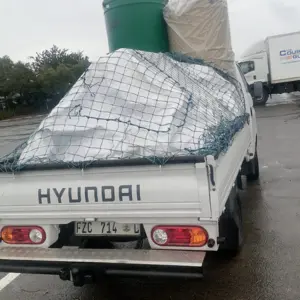
But furniture doesn't care about weight.
A mattress, fridge, couch, dining table and wardrobe may weigh little on their own, but together they take up an enormous amount of space.
Transport isn't about kilograms.
It's about cubic metres.
The Customer Who Turned a Two-Hour Move Into an Eight-Hour Nightmare
One customer, Jabu, taught us a lesson worth sharing.
He was moving from a two-bedroom apartment in Centurion to a new home in Midrand, about 20 kilometres away.
He chose the smallest, cheapest bakkie because he was sure two quick loads would be enough.
Saturday morning proved otherwise.
The double-bed mattress, lounge suite and large double-door fridge filled the load bed almost immediately.
He'd booked an open bakkie, so everything had to be roped down carefully for each leg.
Two loads became four.
Each extra load added to the cost, and the day dragged on.
By the third load, a typical Gauteng afternoon thunderstorm rolled in.
His mattress and fabric couch were soaked through.
What should have been a two-hour job turned into nearly eight.
A closed 3 Ton Bakkie from the start would have carried everything in one safe, dry trip.
The Four Questions We Always Ask Before Recommending a Vehicle
After years in the transport industry, we've found the right questions point to the right vehicle almost immediately.
1. What Is the Longest or Tallest Item You're Moving?
This is usually the deciding factor.
If someone's moving:
- A double-door refrigerator
- A three-seater couch
- A large dining room table
- A king-size mattress
We already know a 1 Ton Bakkie probably isn't the best option.
Some appliances can't be transported safely lying flat, which makes vehicle height matter as much as floor space. A closed 1.5 Ton Bakkie gives you 1.8m of height, a closed 3 Ton Bakkie 2.1m, and a closed 8 Ton Truck 2.4m.
2. Does the Property Have Height Restrictions or Tight Access?
This one surprises many customers.
Modern townhouse complexes often have:
- Low security booms
- Narrow roads
- Sharp corners
- Height-restricted parking
- Strict estate rules
Sometimes a large truck simply can't reach the front door.
In those cases a bakkie, or a smaller truck, is the smarter choice. And if a big vehicle can't get in at all, Loadit's shuttle option lets it wait outside while a 1.5 Ton Bakkie ferries everything through the gate.
3. How Many Hands Will the Load Need?
Every Loadit booking comes with a professional driver, so this isn't about licences or who's behind the wheel.
It's about manpower.
Your driver helps load and offload, but a home full of heavy furniture usually needs more hands. You can add helpers when you book, and the bigger the load and vehicle, the more helpers it's worth having.
4. What Happens If It Starts Raining?
This matters especially in Gauteng's summer.
Furniture, mattresses and electronics on an open bakkie are exposed the moment a thunderstorm arrives.
Open vehicles do come with a weatherproof tarpaulin, but if the forecast looks rough or the load is precious, a closed vehicle is the safer call.
| Closed vehicle | Load height |
|---|---|
| 1.5 Ton Bakkie | 1.8m |
| 3 Ton Bakkie | 2.1m |
| 8 Ton Truck | 2.4m |
When a Bakkie Is Actually the Better Choice
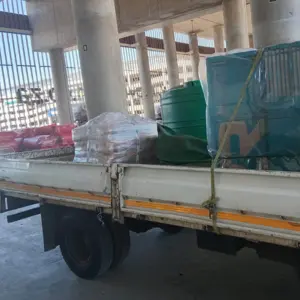
Some people assume a transport company always pushes the bigger vehicle because it costs more.
We don't work that way.
There are plenty of times a bakkie is genuinely the better option.
Moving Into Tight Residential Estates
Some estates just aren't built for large trucks.
A bakkie can often:
- Get down narrow roads
- Fit under low carports
- Turn through tight security entrances
- Park much closer to the door
That can save far more time than a big truck parked hundreds of metres away.
Garden Refuse and Junk Removal
Clearing the garden or the garage is much easier with a low load bed.
A bakkie's lower sides make loading garden refuse and unwanted items quick work. Just bag the smaller stuff so it loads fast, and note that Loadit doesn't collect rubble or paint.
Collecting a Single Large Purchase
If you're collecting:
- A washing machine
- A chest freezer
- A new bed
- A dining table
A bakkie is often perfect.
It parks easily at shopping centres and skips the hassle of steering a large truck through busy parking.
Same-Day and Marketplace Pickups
A bakkie is ideal for quick local errands within Loadit's coverage across Gauteng and the Western Cape, on jobs up to 250km.
It's the easy choice for:
- Same-day store or warehouse collections
- Facebook Marketplace, Gumtree or OLX pickups
- A single appliance or piece of furniture
- A studio or bachelor flat move
Sometimes Bigger Isn't Better Either
We once had a customer who insisted on the biggest truck for a bachelor flat move into a secure Midrand estate.
Despite our advice, they booked it.
When the truck arrived, estate security turned it away for exceeding the axle-weight limit.
The truck had to stay outside the gates.
This is exactly what Loadit's shuttle option is built for: the large vehicle waits outside while a 1.5 Ton Bakkie ferries everything in and out. Better still, a correctly chosen bakkie would have done the whole job on its own.
Sometimes smaller really is smarter.
The Biggest Myth About Bakkie Hire vs Truck Hire
The myth we hear almost every week is:
"A bakkie is always cheaper because the rate is lower."
It sounds logical.
It usually isn't true.
The headline price is only one part of your total moving cost.
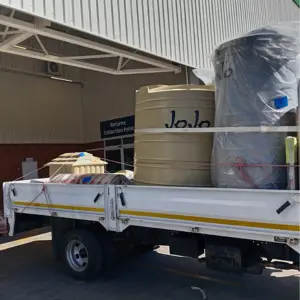
With Loadit, the things that really move the total are:
- Whether it all fits in one load, or needs a second
- The distance and number of stops
- Extra helpers or stairs
- Open versus closed, if the weather turns
- Whether you book on an off-peak date and weekday for the discount
One correctly sized vehicle doing the job in a single load is frequently cheaper than a small one that needs several.
The "Cheap" Bakkie That Became the Most Expensive Option
We once worked with a customer moving from Bryanston to Pretoria.
He picked a 1 Ton Bakkie because the price looked lower than a 3 Ton Bakkie.
He laughed off the suggestion to size up.
"I'll just do two quick loads."
The load didn't fit.
Two loads became several.
Each extra load was charged, and with the distance between Bryanston and Pretoria, those loads added up fast.
By the end, the "cheap" 1 Ton Bakkie had cost almost double what a single 3 Ton Bakkie would have.
The lowest headline price became the most expensive move.
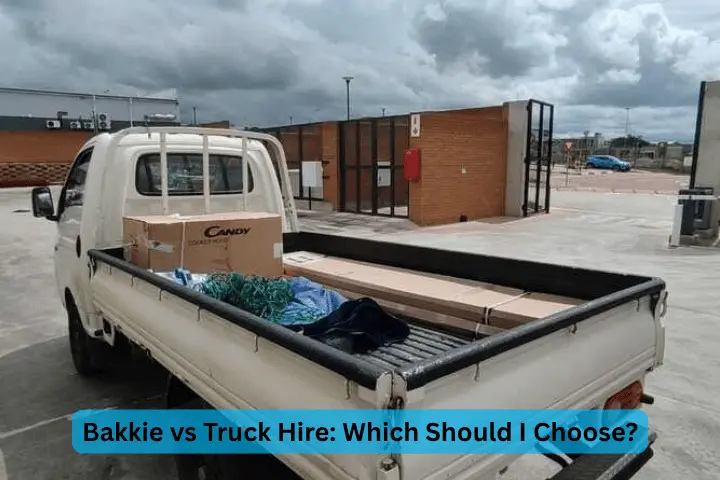
How We Decide Between a Bakkie and a Truck
Our recommendation is usually simple.
Choose a Bakkie If:
- You're moving one or two large items.
- Access is limited.
- You're collecting furniture from a retailer.
- You're clearing garden refuse or unwanted items.
- Your load is relatively small.
Choose a Truck If:
- You're moving an entire home.
- You're relocating an office.
- You have bulky furniture.
- Weather protection matters.
- You want it done in one load.
Our Golden Rule After Years in the Industry
If we could leave you with one lesson before you click "Book Now," it's this:
Don't book a vehicle that fits your belongings exactly.
Leave yourself about 20% spare space.
Think of it like buying a suitcase for an overseas trip.
If you have to sit on it just to close the zip before you've even left home, you're in for a struggle.
Moving works the same way.
Everyone remembers:
- The couch
- The fridge
- The bed
- The dining table
Almost nobody remembers:
- Standing lamps
- Garden tools
- Brooms and mops
- Loose pillows
- Winter blankets
- Last-minute bags full of kitchen bits
Those awkward extras eat up space.
They're usually the reason people end up paying for a second load.
Our advice hasn't changed.
If you think everything will fit tightly into a bakkie, book the 3 Ton Bakkie.
If you think you'll fill the 3 Ton Bakkie, move up to the 8 Ton Truck.
Spending a little more on a slightly larger vehicle is one of the cheapest ways to protect yourself against moving-day stress, an unexpected downpour, damaged furniture and paying for an extra load.
In all our years, no one has complained that their vehicle was slightly too big.
Plenty have wished it was.
You can get a free, all-inclusive quote online in minutes, with no sign-up needed, and the price you see is the price you pay.